Obligation Registry Overview
Obligation Registry support (including the bill-of-exchange profile) is currently in beta. APIs, contract addresses, and behavior may change before the stable release. Use on testnet only and do not rely on this feature in production.
The Obligation Registry is TrustVC's title registry for documents whose lifecycle needs more than "who currently holds it" — it adds a real business status on-chain: has the holder accepted the document, rejected it, or has it already been paid off (discharged)? The first document type built on it is the electronic Bill of Exchange (BoE).
When to use it, and why
Use the Obligation Registry when your document's lifecycle needs the system itself to know:
- Has the holder accepted the document, or rejected it?
- Has the beneficiary been paid — i.e. has the document been discharged?
A Bill of Exchange is the clearest example: a drawee has to formally accept or refuse the bill, and once accepted, the payee is eventually paid and the bill is discharged. None of that can be represented by a registry that only tracks who is holding the document.
Keep using the classic Token Registry / Title Escrow (ETR) for documents where possession is the whole story — an electronic Bill of Lading or a Title Deed doesn't need an accept/reject/discharge step; it only needs to change hands and eventually be surrendered.
| If your document... | Use |
|---|---|
| Only needs to change ownership/holdership and eventually be surrendered (eBL, Title Deed) | Token Registry + Title Escrow (ETR) |
| Also needs a holder to formally accept or reject it, and a beneficiary to mark it paid (Bill of Exchange) | Obligation Registry |
Overview of the Obligation Registry
The Obligation Registry is built from three contracts:
| Contract | Role |
|---|---|
TrustVCToken | The registry contract — an ERC-721 token representing each Bill of Exchange document on-chain. |
ObligationEscrowFactory | Creates a new ObligationEscrow for each minted document. |
ObligationEscrow | Holds a minted document in custody between a beneficiary and a holder, and tracks a status field together with the actions that move it. |
The status lifecycle
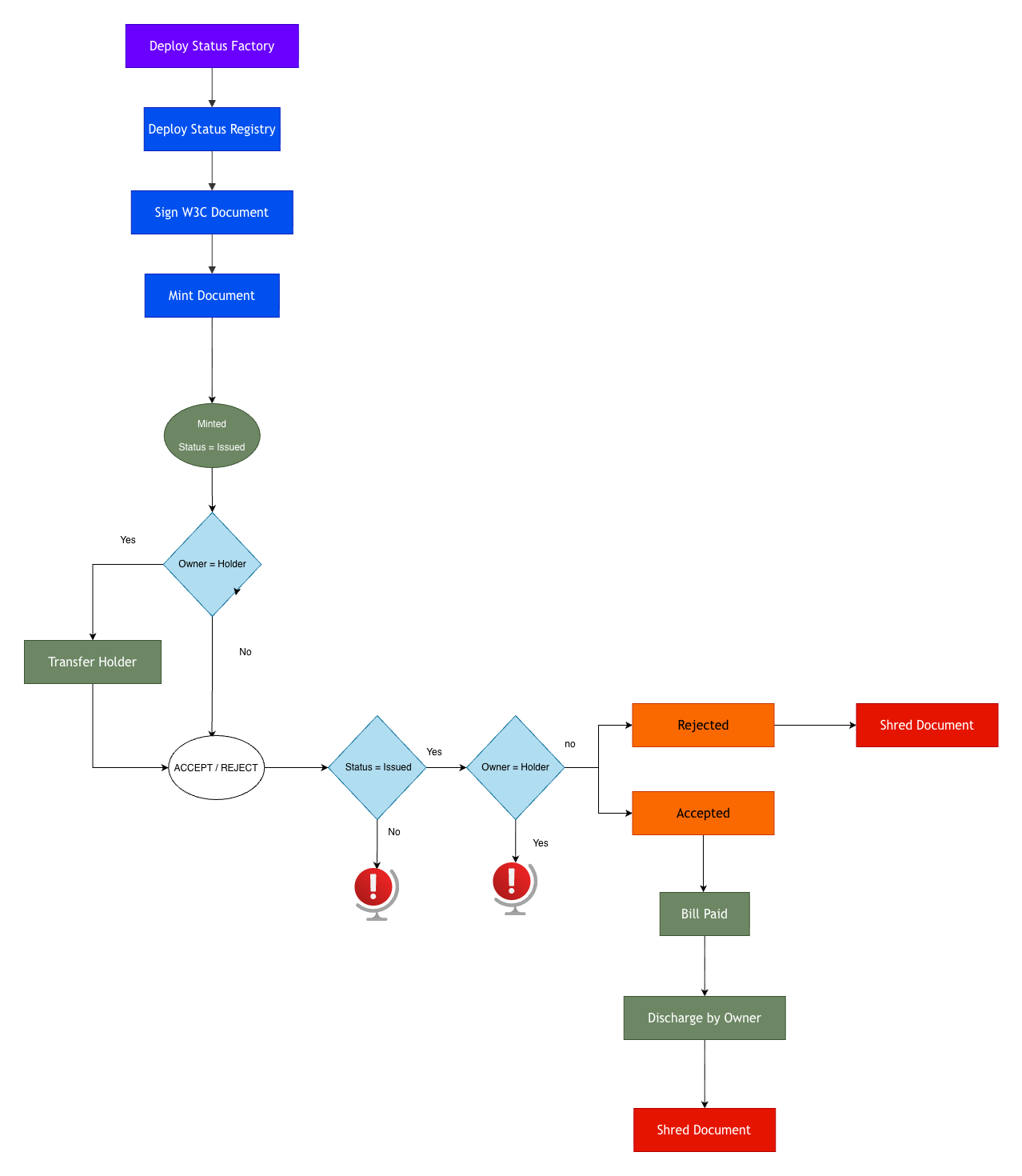
A document moves through the lifecycle above from the moment it's minted (status = Issued) through to Accepted/Rejected and, if accepted and paid, Discharged. The two guard conditions in the diagram (the red markers) are enforced on-chain, not just in the UI:
- Accept / Reject can only be called by the holder, and only while the beneficiary and holder are different parties.
- Discharge can only be called by the beneficiary, once the document is Accepted.
- Reject and Discharge close the title automatically, in the same transaction — the token is handed back to the registry and burned. There's no separate manual burn step for these two paths.
- Return to issuer is an escape hatch: it needs a single wallet holding both beneficiary and holder, works at any point while the escrow is active, and doesn't touch
statusat all — the issuer then accepts (burns) or rejects (restores) the return.
Capabilities
The Obligation Registry supports:
- Minting a document
- Transferring beneficiary / holder (endorsement)
- Returning a document to the issuer (dual role)
- Pausing the registry
- The holder accepting or rejecting the document
- The beneficiary discharging the document
The next pages walk through deploying, minting, endorsing, and reading the endorsement chain for the Obligation Registry.
Obligation Registry is v5-only — there is no v4 equivalent, and classic
token-registry/title-escrowcommands should not be used for obligation documents (they'll fail extraction, since obligation documents carrycredentialStatus.obligationRegistryinstead ofcredentialStatus.tokenRegistry).