Pay on Behalf with EIP-7702
Pay on Behalf transactions are currently in beta. APIs, contract addresses, and behavior may change before the stable release. Use on testnet only and do not rely on this feature in production.
Pay on Behalf is only supported for Token Registry v5 (TR v5) contracts deployed via TDocDeployer. It is not available for earlier token registry versions. See the TR v5 migration guide if you are still on an older registry.
TrustVC supports Pay on Behalf — letting a platform (issuer) cover trade document transaction costs for its users. Users can deploy token registries, mint documents, and perform all title escrow operations without holding ETH, while gas is sponsored on their behalf by a PlatformPaymaster.
Under the hood, this is implemented as a gasless transaction flow using EIP-7702 (smart account delegation) and ERC-4337 account abstraction — the "Pay on Behalf" name describes the outcome for the user (the platform pays), while "gasless" describes the underlying mechanism you'll see referenced in code and function names.
Architecture
The system is built on three smart contracts:
| Contract | Role |
|---|---|
EIP7702Implementation | Shared smart account logic. EOAs delegate to this once via a type-4 transaction — their bytecode becomes 0xef0100 || impl_address, giving them full smart-account capability while keeping the same address and private key. |
PlatformPaymaster | Per-platform ERC-4337 paymaster deployed as a minimal-proxy clone. Sponsors gas for registry deploys, mints, and title escrow operations within configured limits. |
PlatformAccountFactory | Deploys PlatformPaymaster clones deterministically via CREATE2. Cheap (~55 k gas) and the clone address is predictable before deployment. |
How it works
The flow splits into a one-time admin setup (done once by the platform) and the user experience (repeated for every action the user takes). The user never sees a gas prompt or needs to hold ETH.
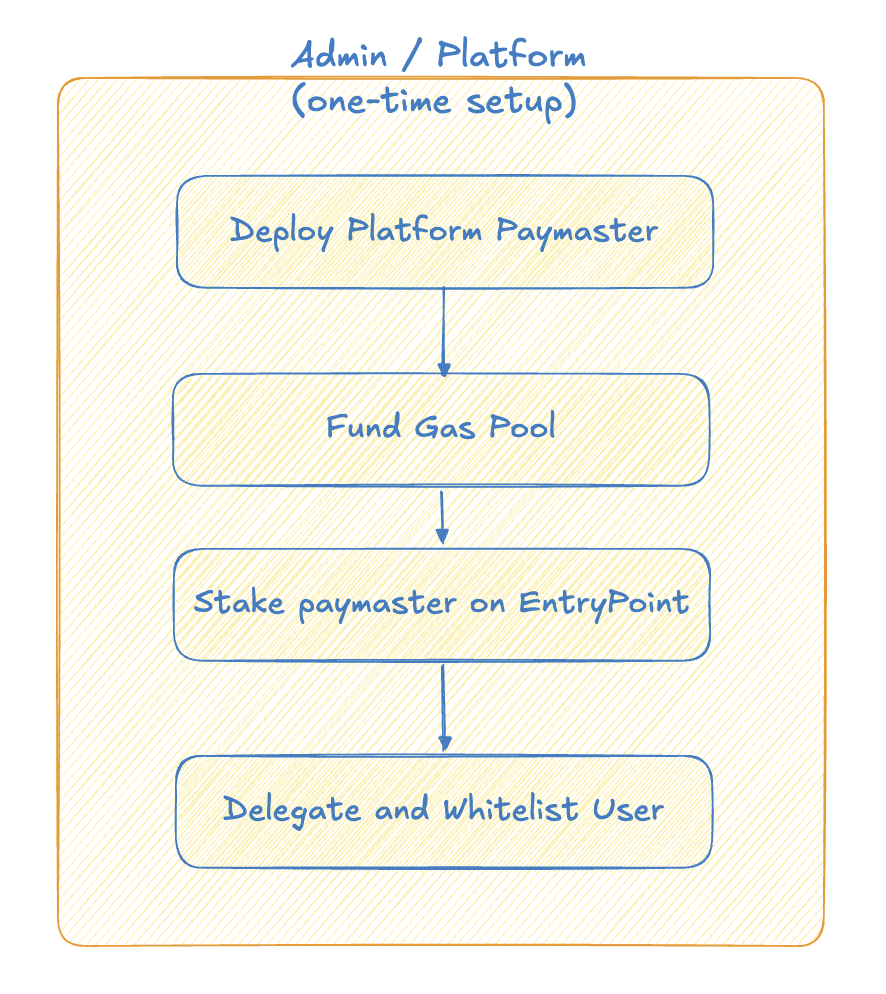
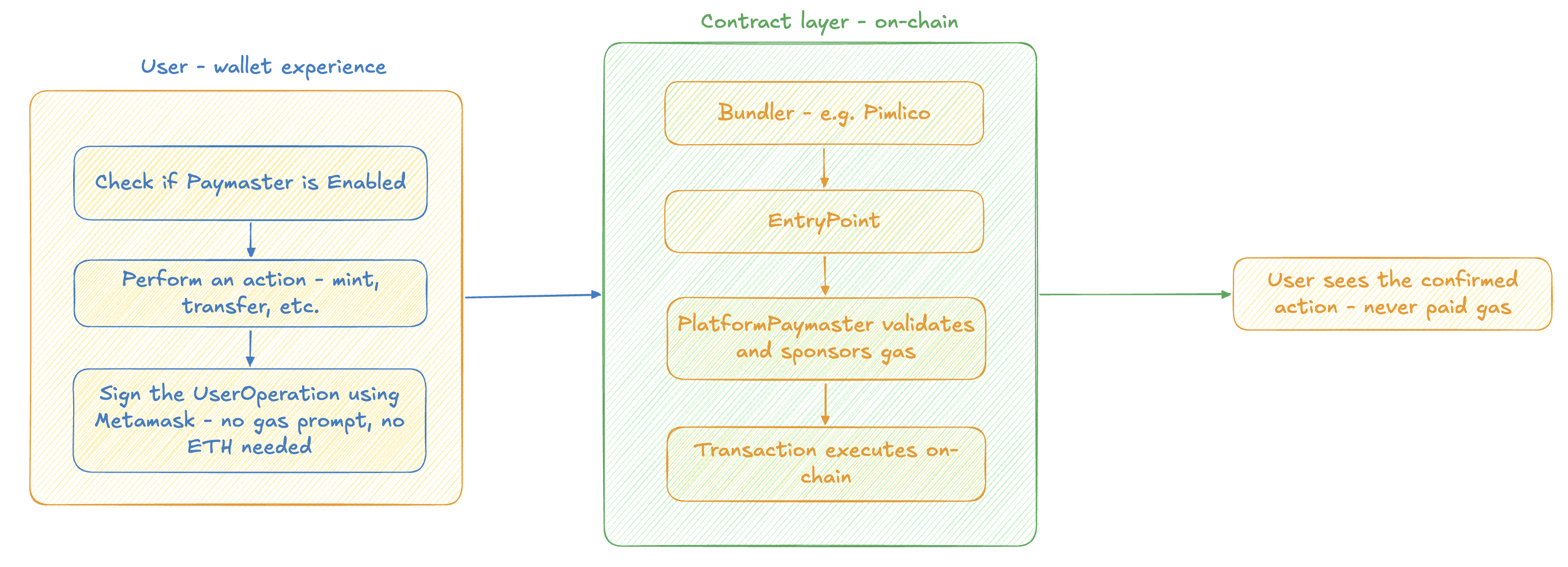
In text form, the same flow:
[One-time, separate step] EOA delegates to EIP7702Implementation via a type-4 transaction
  - User-owned wallet:      user signs the authorization off-chain, platform owner submits it
  - Platform-managed wallet: platform owner both signs and submits (it holds the key)

User (EOA, no ETH, already delegated)
  │
  │  1. Submit UserOperation via a bundler
  │
  ▼
Bundler
  │
  │  2. Calls EntryPoint → validates against PlatformPaymaster
  │
  ▼
PlatformPaymaster
  │
  ├── Path A — Title escrow / registry calls
  │     Checks: caller ∈ authorizedCallers, target ∈ authorizedRegistries or authorizedTitleEscrows
  │     Enforces: dailyLimit per user
  │
  └── Path B — deployRegistry / mintDocument on the paymaster itself
        deployRegistry: userWhitelist[sender] > 0 (platform whitelists users)
        mintDocument:   caller has MINTER_ROLE on the registry
Deployed addresses
Sepolia (chainId: 11155111)
| Contract | Address |
|---|---|
| EIP7702Implementation | 0xa46EC3920Ac5fc54F4bA33185A91ae250aDF59B8 |
| PlatformPaymaster (implementation) | 0xa24695178ea881ab7d4d105106e4906a8da4752b |
| PlatformAccountFactory | 0x7e9ef6363180baa744eb32ceab367a44f52adc9f |
| TDocDeployer | 0x64bc665056DC8bE4092e569ED13a7F273Be28cD2 |
| EntryPoint v0.8 | 0x4337084D9E255Ff0702461CF8895CE9E3b5Ff108 |
Polygon Amoy (chainId: 80002)
| Contract | Address |
|---|---|
| EIP7702Implementation | 0x044de1d4515a76ed9e431e8ec89e8d600405fd86 |
| PlatformPaymaster (implementation) | 0x1c4367128933E9a88de26C723F50C288fA0fFea7 |
| PlatformAccountFactory | 0xfbe1d336000d567f98ac5318f7c0144501388409 |
| TDocDeployer | 0xfcafea839e576967b96ad1FBFB52b5CA26cd1D25 |
| EntryPoint v0.8 | 0x4337084D9E255Ff0702461CF8895CE9E3b5Ff108 |
SDK package
The @trustvc/trustvc SDK exposes all Pay on Behalf functions under the eip7702-functions namespace. Install it once:
npm install @trustvc/trustvc@beta
Import any function directly:
import {
  deployTokenRegistryGasless,
  mintGasless,
  transferHolderGasless,
  transferBeneficiaryGasless,
  transferOwnersGasless,
  nominateGasless,
  returnToIssuerGasless,
  rejectReturnedGasless,
  acceptReturnedGasless,
  rejectTransferHolderGasless,
  rejectTransferBeneficiaryGasless,
  rejectTransferOwnersGasless,
} from "@trustvc/trustvc";
These SDK functions keep the Gasless suffix (their actual exported names), even though the feature is presented to platforms and end users as Pay on Behalf. The suffix refers to the underlying mechanism; the name doesn't change based on which bundler or paymaster infrastructure you use.
Contract addresses via gaslessConstants
The SDK also exports a gaslessConstants object with all deployed contract addresses, so you don't need to hard-code them:
import { gaslessConstants } from "@trustvc/trustvc";

// Sepolia
gaslessConstants.GASLESS_EIP7702_IMPL_ADDRESS_SEPOLIA
gaslessConstants.GASLESS_PAYMASTER_IMPL_ADDRESS_SEPOLIA
gaslessConstants.GASLESS_FACTORY_ADDRESS_SEPOLIA
gaslessConstants.TDOC_DEPLOYER_ADDRESS_SEPOLIA

// Polygon Amoy
gaslessConstants.GASLESS_EIP7702_IMPL_ADDRESS_AMOY
gaslessConstants.GASLESS_PAYMASTER_IMPL_ADDRESS_AMOY
gaslessConstants.GASLESS_FACTORY_ADDRESS_AMOY
gaslessConstants.GASLESS_TDOC_DEPLOYER_ADDRESS_AMOY

// Shared (same on all supported chains)
gaslessConstants.GASLESS_ENTRY_POINT
These are as const typed 0x${string} values — pass them directly to any SDK function or viem/ethers call without casting.
ABI exports
Contract ABIs are also exported if you need to decode logs or make low-level calls:
import { eip7702Abis } from "@trustvc/trustvc";
// eip7702Abis.PlatformPaymaster, eip7702Abis.EIP7702Implementation, etc.
Prerequisites
Before calling any Pay on Behalf function you need:
- A PlatformPaymaster deployed for your platform — see Setup.
- A bundler/paymaster provider API key — see Setup for a walkthrough using Pimlico as an example.
- The user's EOA delegated — a separate, one-time type-4 transaction, submitted before the user's first sponsored action (not as part of it). Two ways to get there:
- User-owned wallet: the user's wallet signs an EIP-7702 authorization off-chain, and the platform owner submits it on-chain (paying its gas) to delegate the EOA to
EIP7702Implementation. - Platform-managed wallet: the platform owner creates the wallet on the user's behalf and, holding its key, both signs the authorization and submits the delegation itself.
- User-owned wallet: the user's wallet signs an EIP-7702 authorization off-chain, and the platform owner submits it on-chain (paying its gas) to delegate the EOA to
- A built
smartAccountClient— the permissionlessSmartAccountClientwrapping the delegated EOA.
All four are covered in Setup. Once set up, jump to Operations for code examples. If you're looking for how this is exposed on the TT Verify page, see Pay on Behalf on TT-web.
Disclaimer
Pay on Behalf is one possible way to sponsor a user's transaction costs. This reference implementation uses EIP-7702 smart account delegation together with Pimlico as an example bundler and paymaster infrastructure provider. Pimlico is referenced here only because it's what this implementation is built and tested against — TrustVC does not require, endorse, or favor Pimlico over any other provider. Any ERC-4337-compatible bundler and paymaster infrastructure that supports EIP-7702 can be substituted.